
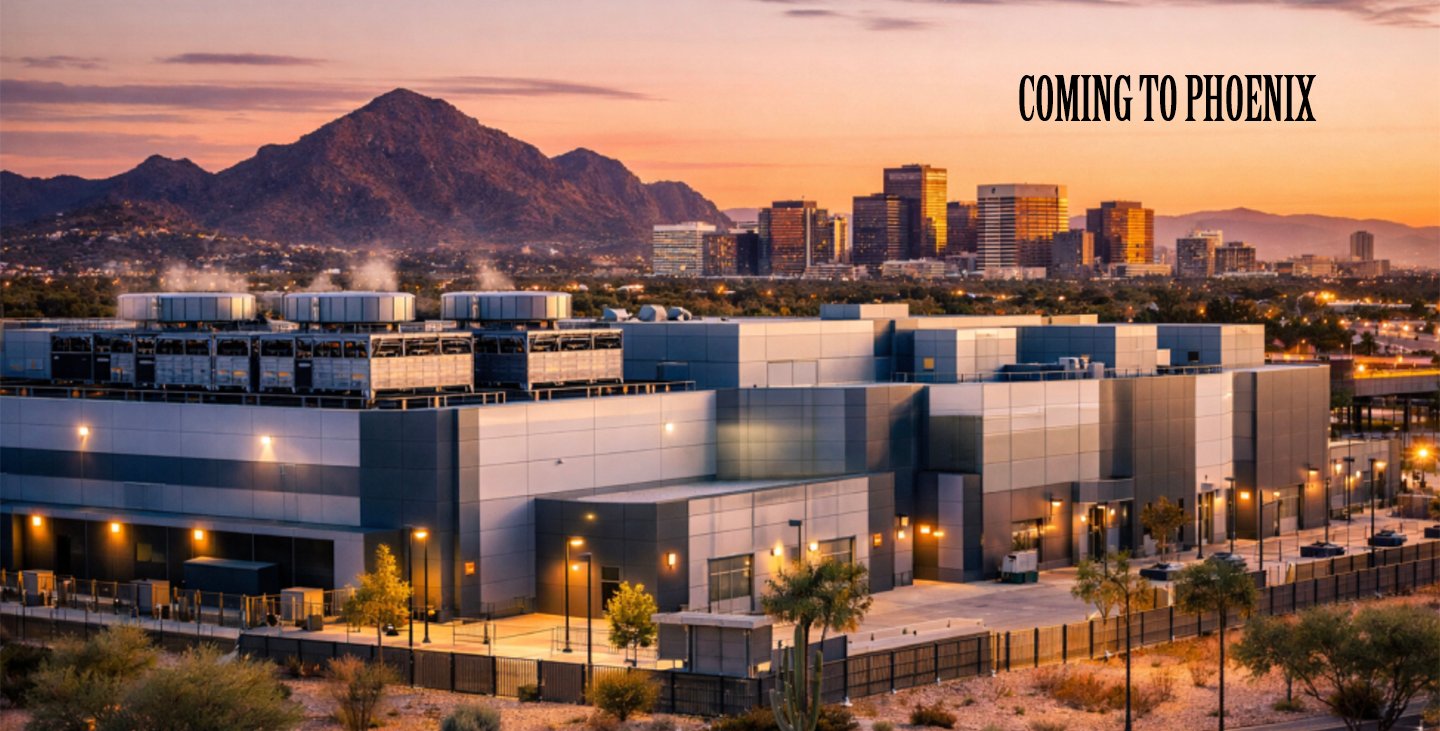
The Desert Servers: Phoenix’s Data Center Boom Meets Arizona’s Water Reality
Phoenix has quietly become one of the hottest data center markets in North America. Metro Phoenix ranks #2 in the U.S. for planned development, behind only Northern Virginia.
Over 140–150 facilities are already operating in Maricopa County, with hundreds more in the pipeline or under construction—think massive campuses from Google (a $1B project in Mesa), Meta, Microsoft, Amazon Web Services, Compass Datacenters (multiple buildings in Goodyear), Stack Infrastructure, NTT, and newer proposals like Takanock’s project near Luke Air Force Base (including two data centers plus a 700MW natural gas plant) and NTT’s revisions in Mesa. 
Why Here?
Cheap-ish land, tax incentives, decent connectivity, abundant solar potential for power, and a climate where dry air helps with some cooling tech. AI demand is supercharging it all—hyperscalers need space for the exploding compute required by training and running models.
Total pipeline: around 1,300 MW under construction and over 4,000 MW planned in the Valley. That’s a lot of servers humming 24/7.
But Arizona is desert country with a well-documented water problem. The state relies heavily on the over-allocated Colorado River (facing deeper cuts), shrinking groundwater aquifers, and long-term drought.
Population growth and agriculture (which still uses the lion’s share—roughly 70% statewide, and about 35% even in the Phoenix metro) add pressure.
Cities have already restricted new residential development in some areas to protect groundwater. So when data centers—known for their cooling needs—cluster here, people rightly ask: How much water are we talking about, and is this sustainable?
The Water Numbers: Direct Cooling vs. The Bigger Picture
Data centers cool thousands of servers to prevent overheating. Traditional evaporative cooling (water mist or cooling towers) can use significant volumes—estimates for an average facility range from tens of thousands to millions of gallons per day, depending on size, design, and load (especially AI racks that run hotter). 
• A 2025 Ceres analysis estimated Phoenix-area data centers were using about 385 million gallons per year for on-site cooling at that time, with projections up to 3.8 billion gallons annually if all planned capacity comes online.
That worst-case scenario would equal roughly 1% of residential water use in the metro area or less than 0.5% of total regional water consumption. 
• More recent local calculations put 2025 data center direct water use in Arizona/Maricopa County around 905 million gallons—about 0.12% of the county’s total water on a daily basis. For context, golf courses in the same area use far more (around 3.8%, or 29 billion gallons). 
• Indirect water use (from generating the electricity that powers the centers) can be larger—potentially hundreds of millions more gallons tied to power plants—but even combined projections don’t dwarf agriculture or existing industrial users like mines and power plants.
State data shows overall industrial water use in the Phoenix metro has stayed relatively flat despite the boom. 
Individual examples make headline
One Meta facility in Goodyear was reported to use around 56 million gallons annually (equivalent to hundreds of households). A single proposed site years ago raised flags for potentially drawing 1.75 million gallons/day.
But many operators now use reclaimed wastewater (not potable/drinking water), closed-loop recycling, or shift to air/adiabatic cooling that performs well in Phoenix’s dry heat.
Microsoft is piloting zero-water cooling designs specifically for desert sites like Phoenix, combining liquid cooling on chips with higher-temperature air rejection—aiming to cut water use dramatically or eliminate it for cooling in some cases. 
The real strain isn’t always “direct sipping” from the tap—it’s cumulative pressure on local utilities, groundwater in stressed basins, and peak-season demand during extreme heat.
If growth continues unchecked, some models warn of noticeable increases in water stress (up to 32% in certain scenarios for the region).
Yet so far, the sky-is-falling predictions haven’t fully materialized, partly because of efficiency gains and because data centers remain a small slice compared to farming or even recreational uses.
Power Strain and Other Trade-Offs
Water isn’t the only issue. Data centers are power hogs, and Arizona’s grid is feeling it—utilities like APS are adding more natural gas capacity in response, even as some hyperscalers (Google, Meta, etc.) pair their campuses with new solar and battery projects.
There’s debate over who pays: Some big operators signed a “Ratepayer Protection Pledge” to fund their own power infrastructure, but not all Arizona projects are covered, raising concerns that residential and small-business ratepayers could foot part of the bill indirectly.
Noise, land use near neighborhoods, and zoning have also prompted city responses in Phoenix, Mesa, Chandler, and elsewhere—new rules on setbacks, height, and noise, but no outright bans.
On the positive side: These projects bring construction jobs, long-term tax revenue (one Google campus alone projected at $156M over 25 years), and economic activity tied to the digital/AI economy.
Arizona is positioning itself as a tech hub, with data centers enabling everything from cloud services to AI advancements that could benefit broader industries.
The Honest Take
Arizona’s water challenges are real and structural—decades in the making from drought, river over-allocation, and growth. Data centers aren’t the primary villain (agriculture and population still dominate), but they’re a visible, growing user in a place where every drop counts.
Secrecy around exact usage from some operators doesn’t help public trust. At the same time, the industry is adapting: more reclaimed water, efficiency tech, and zero-water pilots show it’s possible to reduce impact.
The tension is classic: economic growth and innovation versus long-term resource sustainability in an arid region. Phoenix-area leaders are trying to thread the needle with policies for “responsible” development rather than halting it.
Whether the boom delivers net benefits without exacerbating shortages will depend on transparency, continued efficiency improvements, and honest accounting of both direct and indirect footprints.
What do you think—should cities prioritize stricter water caps or reclaimed-only rules for new centers? Or is the tax/jobs upside worth the calculated risk, especially with tech evolving fast?