Native American Jim Thorpe: The Greatest Athlete in the World had his Olympic Metal Stripped Away
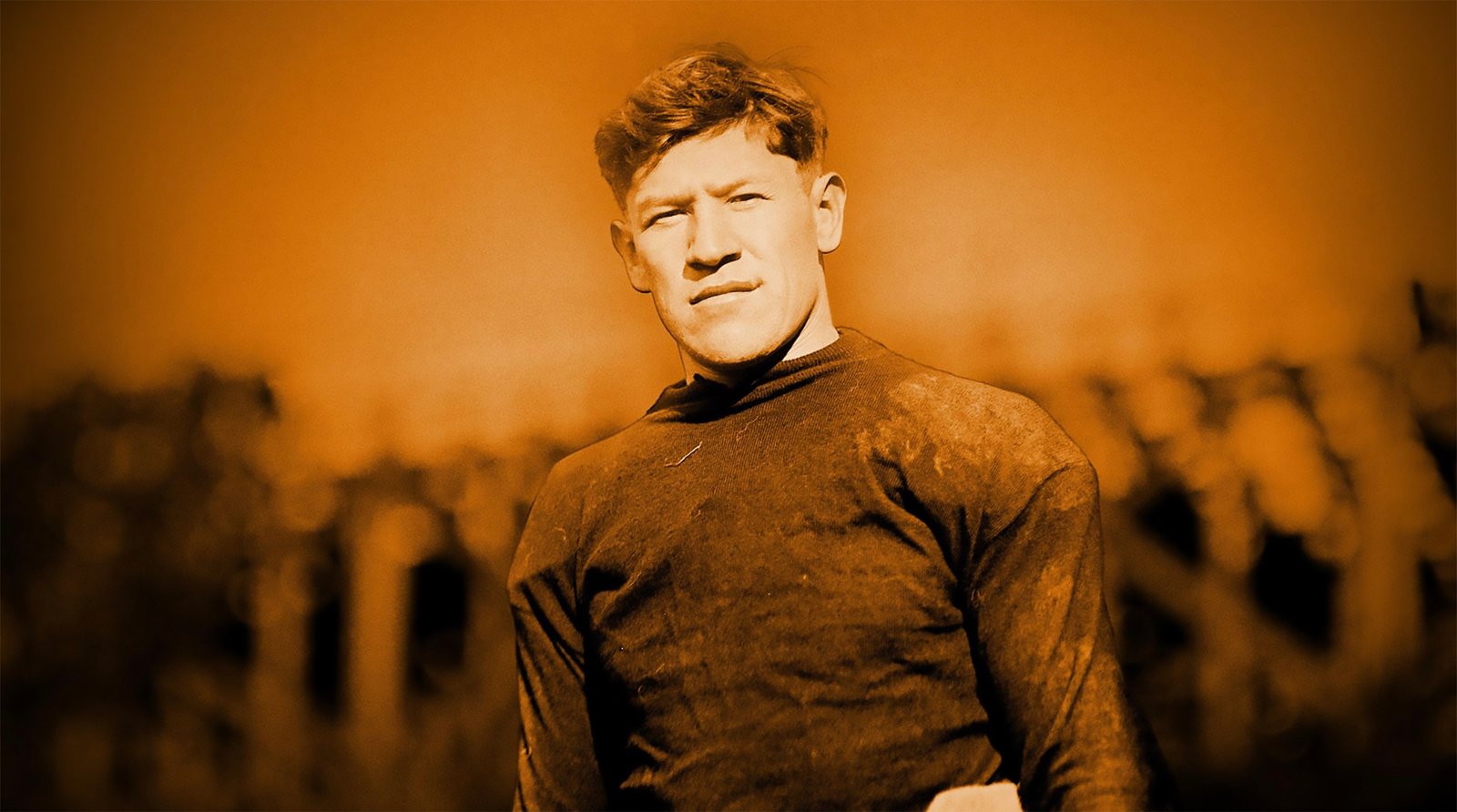
Jim Thorpe was born on May 22, 1888, in Indian Country near Prague, Oklahoma, a descendant of Chief Black Hawk. Jim’s father was Fox, Sac and white, his mother Potawatomi and white. His Native birth-name, Wa-Tho-Juk, meant “Bright Path.” At age eight, his twin brother, Charlie, died of pneumonia.
For the rest of his life, Jim believed that Charlie had given him his own strength before dying and felt his brother’s presence was with him always. Jim was 14 when he lost his mother, and 17 when his father died.
Jim Thorpe indeed followed one of the brightest paths in United States athletic history, excelling in football, baseball, and Olympics competition. He was selected by the Associated Press as the greatest athlete of the first half of the twentieth century, and the twentieth century’s greatest athlete by ABC Sports.
In the summer of 1912, a twenty-four-year-old Sac and Fox man named Jim Thorpe walked onto the track at the Stockholm Olympics and did something no one had ever seen.
He won the pentathlon.
He won the decathlon.
He set a record that stood for two decades.
King Gustav V of Sweden told him, “You, sir, are the greatest athlete in the world.” Thorpe’s reply became legend: “Thanks, King.”
The medals were the headline. The silence was the crime.
He didn’t just win — he made the other athletes look like they were competing in a different sport!
The pentathlon alone had five events: long jump, javelin, discus, 200 meters, and 1500 meters. He won four of them outright and finished third in the 1500, which he barely trained for.
His total was 7,096 points. The silver medalist had 6,895. A gap of over two hundred points in a five-event contest is absurd.
Then the decathlon
Ten events over two days — 100 meters, long jump, shot put, high jump, 400 meters, 110-meter hurdles, discus, pole vault, javelin, and 1500 meters.
He won four events outright, placed in the top four in every single one, and finished with 8,412.96 points. The silver medalist had 7,724.95. Nearly 700 points ahead. Nobody has come close to that margin since.
The 1500 meters on the final day is the detail that gets me. He’d already won eight events across two competitions. He was exhausted, and he still ran a 4:44.8 — fast enough to place fourth in that event alone. Most decathletes today would be thrilled with that time in isolation.
He also tied for fourth in the high jump and third in the long jump at the same Games, events he wasn’t even entered in as a specialist. The man was a freak of nature who happened to be built like a linebacker and moved like a sprinter.
That’s the part the AAU couldn’t take away. They took the medals. They couldn’t take the performances.
Victim of Racism
Thorpe, whose parents were both mixed-race, was raised as a Native American. He accomplished his athletic feats despite the severe racial inequality of the United States.
It has often been suggested that his Olympic medals were stripped by the athletic officials because of his ethnicity. While it is difficult to prove this, the public comment at the time largely reflected this view.
At the time Thorpe won his gold medals, not all Native Americans were recognized as U.S. citizens (the U.S. government had frequently demanded that they make concessions to adopt European-American ways to receive such recognition). Citizenship was not granted to all American Indians until 1924.
When Thorpe attended Carlisle, the students’ ethnicity was used for marketing purposes. The football team was called the Indians. To create headlines, the school and journalists often portrayed sporting competitions as conflicts of Indians against white.
The first notice of Thorpe in The New York Times was headlined “Indian Thorpe in Olympiad; Redskin from Carlisle Will Strive for Place on American Team.” Throughout his life, Thorpe’s accomplishments were described in a similar racial context by other newspapers and sportswriters, which reflected the era.
The Amateur Athletic Union Stripped his Metals
The Amateur Athletic Union discovered he’d played semi-pro baseball for a few dollars a game in North Carolina. Under the rules of the era, that made him a professional. They stripped his medals in 1913. He never got a hearing. He never got to defend himself.
The same year, the AAU’s own president was quietly taking money from athletes. Nobody touched him.
Thorpe spent the rest of his life playing pro ball, acting in Hollywood westerns, and watching the world forget what he’d done. He died in 1953, broke and mostly ignored.
In 1983, the IOC restored his medals — thirty years too late for him to hold them. His daughter accepted them in Los Angeles.
Honors
Thorpe’s tribe, the Sac and Fox Nation, added Olympic rings to their official flag to honor him.
Thorpe’s monument, featuring the quote from Gustav V “You, sir, are the greatest athlete in the world,” still stands near the town named for him, Jim Thorpe, Pennsylvania. The grave rests on mounds of soil from Thorpe’s native Oklahoma and from the stadium in which he won his Olympic medals.
Thorpe’s Achievements
Thorpe’s achievements received great acclaim from sports journalists, both during his lifetime and since his death. In 1950, an Associated Press poll of almost 400 sportswriters and broadcasters voted Thorpe the “greatest athlete” of the first half of the 20th century.
That same year, the Associated Press ranked Thorpe as the “greatest American football player” of the first half of the century. Pro Football all Hall of Fame Pro voters selected him for the NFL 50th Anniversary All-Time Team in 1967.
In 1999, the Associated Press placed him third on its list of the top athletes of the century, following Babe Ruth and Michael Jordan. ESPN ranked Thorpe seventh on their list of best North American athletes of the century.
Thorpe was inducted into the Pro Football Hall of Fame in 1963, one of seventeen players in the charter class. Thorpe is memorialized in the Pro Football Hall of Fame rotunda with a larger-than-life statue. He was also inducted into halls of fame for college football, American Olympic teams, and the national track and field competition.
In 2018, Thorpe became one of the inductees in the first induction ceremony held by the National Native American Hall of Fame. The fitness center and a hall at Haskell Indian Nations University are named in honor of Thorpe.
President Richard Nixon, as authorized by U.S. Senate Joint Resolution 73, proclaimed Monday, April 16, 1973, as “Jim Thorpe Day” to promote nationwide recognition of Thorpe’s life.
In 1986, the Jim Thorpe Association established an award with Thorpe’s name. The Jim Thorpe Award is given annually to the best defensive back in college football.
The annual Thorpe Cup athletics meeting is named in his honor. The United States Postal Service issued a 32¢ stamp on February 3, 1998, as part of the Celebrate the Century stamp sheet series.
In a poll of sports fans published in 2000 by ABC Sports, Thorpe was voted the Greatest Athlete of the Twentieth Century; the pool of 15 other top athletes included Muhammad Ali, Pele Babe Ruth, Jesse Owens, Jesse Owens, Wayne Gretzy, Jack Nicklaus, and Michael Jordan.
Later life, film career, and death
After his athletic career, Thorpe struggled to provide for his family. He found it difficult to work a non-sports-related job and never held a job for an extended period of time.
During the Great Depression, in particular, he had various jobs, among others as a movie actor, mostly as an extra, usually playing an American Indian in Westerns, starting with the 1931 serial Battling with Buffalo Bill.
In the 1932 comedy Always Kickin,’ Thorpe was prominently cast in a speaking part as himself, a kicking coach teaching young football players to drop-kick. He played the captain of the guard in 1935’s She, an umpire in the 1940 film Knute Rockne, All American, and a member of the Navajo Nation in the 1950 film Wagon Master. An American Indian Magazine article states Thorpe appeared in over 70 films.
In 1931, during the Great Depression, Thorpe sold the film rights to his life story to MGM for $1,500 (equivalent to $32,000 in 2025). Warner Bros. eventually acquired the rights and memorialized Thorpe in Jim Thorpe – All-American (1951), starring Burt Lancaster The film was directed by Michael Curtiz. Although there were rumors that Thorpe received no money, he was paid $15,000 by Warner Bros. plus a $2,500 donation toward an annuity for him by the studio’s head of publicity.
The movie included archival footage of the 1912 and 1932 Olympics. Thorpe was seen in one scene as a coaching assistant. It was also distributed in the United Kingdom, where it was called Man of Bronze.
Apart from his career in films, he worked as a construction worker, a doorman/bouncer, a security guard, and a ditch-digger. He briefly joined the The United States Merchant Marine in 1945, during World War II. Thorpe was a chronic alcoholic during his later life. He ran out of money sometime in the early 1950s.
When hospitalized for lip cancer in 1950, Thorpe was admitted as a charity case
At a press conference announcing the procedure, his wife, Patricia, wept and pleaded for help, saying, “We’re broke … Jim has nothing but his name and his memories. He has spent money on his own people and has given it away. He has often been exploited.”
In early 1953, Thorpe went into cardiac arrest dining with Patricia in their home in Lomita, California. He was briefly revived by artificial respiration and spoke to those around him, but lost consciousness shortly afterward. He died on March 28 at the age of 65.