
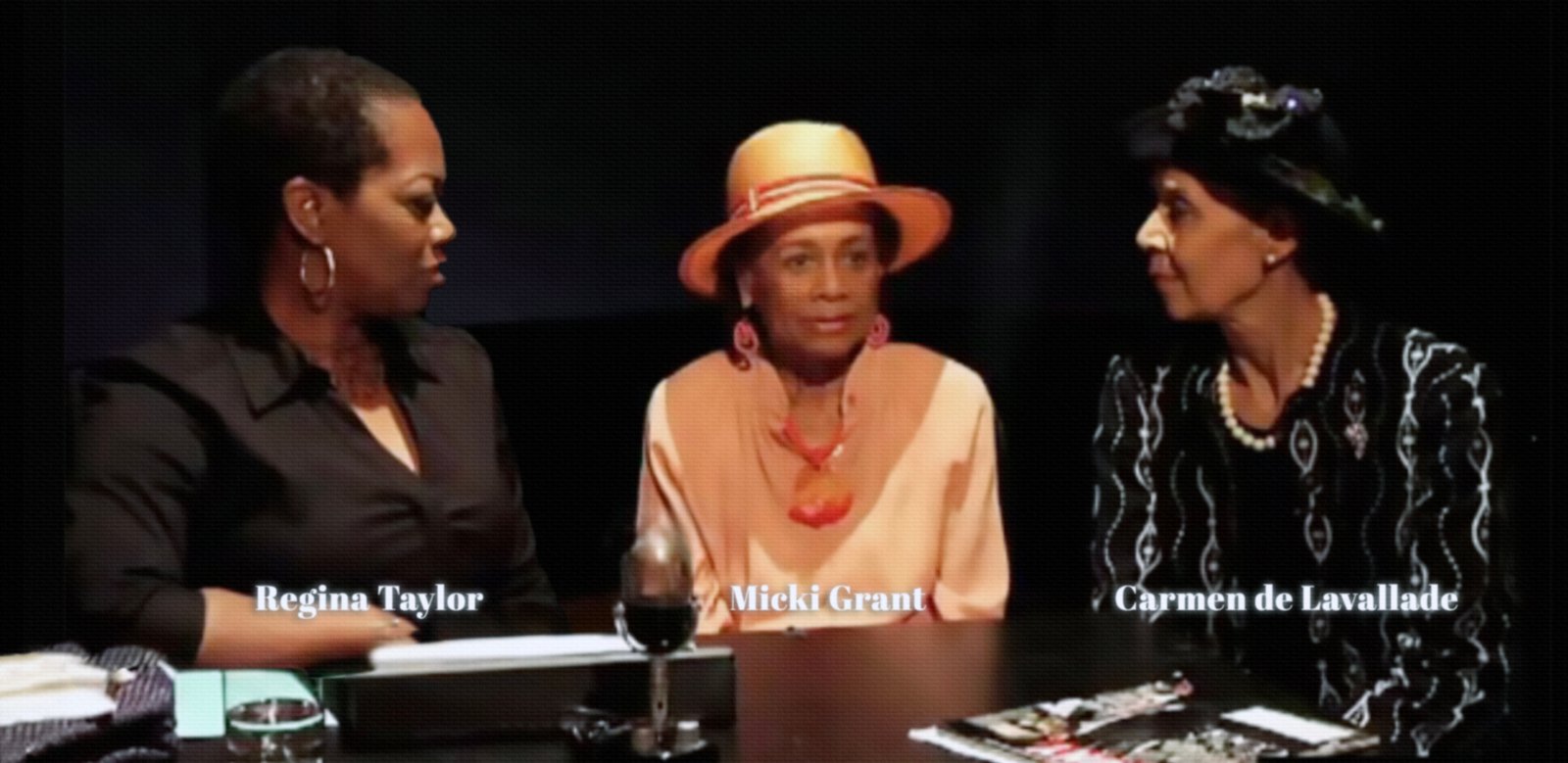
Three Legendary Trailblazing Women Share Their Stories, Regina Taylor, Micki Grant & Carmen de Lavallade
Regina Taylor
Regina Annette Taylor (born August 22, 1960) is an American actress, playwright, director, educator, and activist whose career has spanned stage, television, and film for more than four decades. She is widely recognized for her Golden Globe–winning performance as Lilly Harper in the NBC drama I’ll Fly Away and for her work as a playwright, including the frequently produced musical Crowns.
Early Life and Education
Taylor was born in Dallas, Texas, the only child of Nell Taylor, a social worker and poet. She spent part of her childhood in Muskogee, Oklahoma, after her family moved there when she was twelve, and later returned to Dallas. She has spoken of becoming acutely aware of racial bias while attending a newly integrated school in Muskogee. She graduated from L. G. Pinkston High School in 1977 and earned a Bachelor of Fine Arts from Southern Methodist University in 1981.
She initially studied journalism and English and considered writing her primary path. An acting class, together with a chance encounter involving Henry Fonda on the SMU campus, redirected her toward performance.
While still a student she appeared in the television films Nurse (1980) and Crisis at Central High (1981). In the latter she portrayed Minnijean Brown of the Little Rock Nine; The New York Times critic John O’Connor praised the work.
Stage Career
After graduation Taylor moved to New York. She worked Off-Broadway and in repertory before joining a Shakespeare company led by Estelle Parsons under Joseph Papp’s New York Shakespeare Festival.
In the 1986–87 Broadway season she appeared in As You Like It and Macbeth and became the first Black woman to play Juliet in Romeo and Juliet on Broadway.
She later earned a Dramalogue Award for Ariel in The Tempest at La Jolla Playhouse and continued to work on and Off-Broadway in productions including Machinal, A Map of the World, and Jar the Floor.
Screen Work
Taylor’s first widely noticed film role was Mrs. Carter, a drug-addicted mother, in Lean on Me (1989). Subsequent film credits include Spike Lee’s Clockers (1995), Losing Isaiah (1995), Courage Under Fire (1996) opposite Denzel Washington, and The Negotiator (1998) opposite Samuel L. Jackson. Later films include Saturday Church.
On television she achieved her greatest popular recognition as Lilly Harper, the intelligent and quietly resolute housekeeper in I’ll Fly Away (1991–1993). The role brought a Golden Globe Award for Best Actress in a Television Series – Drama, multiple NAACP Image Awards, and two Primetime Emmy nominations.
She was a series regular as Molly Blane on CBS’s The Unit (2006–2009) and received another NAACP Image Award for that work. Other notable television roles include Anita Hill in the HBO film Strange Justice (Gracie Award), the title character in PBS’s Cora Unashamed (the first African American lead on Masterpiece Theatre), and later appearances in Lovecraft Country, The First Lady (as Marian Robinson), The Blacklist, The Good Fight, The Red Line, and All Day and a Night.
Playwriting, Directing, and Teaching
Taylor is an artistic associate of Chicago’s Goodman Theatre and its most produced playwright. Her works include Crowns (one of the most frequently performed musicals in the country in 2006 and winner of four Helen Hayes Awards, including Best Direction), Drowning Crow (Broadway), Oo-Bla-Dee (Steinberg/ATCA Award), Magnolia, The Trinity River Plays, and stop.reset. She has also written for Audible and other commissions.
In 2017 she was appointed the Denzel Washington Endowed Chair in Theater at Fordham University. She has served as playwright-in-residence at the Repertory Theatre of St. Louis through the Mellon Foundation’s National Playwright Residency Program and has received honorary doctorates from DePaul University and Columbia College Chicago.
Personal Life and Legacy
Taylor married artist Mario Emes (also identified as Michael Schurian) in 1982. She is a member of Alpha Kappa Alpha sorority. Ancestry analysis has indicated descent primarily from the Mende people of Sierra Leone and the Kru people of Liberia.
She has described herself as an introvert who came to acting later than writing and who values the “flashes of light into the human spirit” that performance can reveal.
Taylor’s career is distinguished by barrier-breaking classical work, critically acclaimed dramatic roles that often explore dignity amid racial and social constraint, and a substantial body of original plays that have entered the American regional-theater repertory. She continues to act, write, direct, and teach.
Micki Grant
Micki Grant (born Minnie Louise Perkins; June 30, 1929 – August 21, 2021) was an American singer, actress, composer, lyricist, and playwright. She made Broadway history in 1972 as the first woman to write the book, music, and lyrics of a musical—Don’t Bother Me, I Can’t Cope—and to star in it. She was also the first woman to win a Grammy Award for Best Score from an Original Cast Show Album.
Early Life and Education
Grant was born in Chicago to Oscar and Gussie (Cobbins) Perkins. She demonstrated early talent in music, poetry, and performance: she wrote poems by age eight, studied piano and later double bass, and appeared in community theater by her late teens.
After Englewood High School she attended the Chicago School of Music and the University of Illinois at Chicago. One semester short of graduation she left for Los Angeles to pursue performing.
She later completed a bachelor’s degree summa cum laude in English and theatre at Lehman College (CUNY). She sometimes gave her birth year as 1941 for professional reasons; contemporary sources confirm 1929.
In 1959 her song “Pink Shoe Laces,” recorded by Dodie Stevens, reached No. 3 on the Billboard Hot 100.
Stage Career as Performer
Grant moved to New York after appearing in the revue Fly Blackbird, which transferred Off-Broadway in 1962. She performed in Jean Genet’s The Blacks (with James Earl Jones and Cicely Tyson), Brecht on Brecht (singing “Pirate Jenny”), The Cradle Will Rock, Jericho-Jim Crow and Tambourines to Glory (both associated with Langston Hughes), To Be Young, Gifted and Black, and Leonard Bernstein’s Theatre Songs.
Her Broadway acting debut came in 1963 as Marietta Johnson in Hughes’s Tambourines to Glory.
In the mid-1990s she toured nationally as Sadie Delany in Having Our Say: The Delaney Sisters’ First 100 Years, winning a Helen Hayes Award. The production also played in Johannesburg.
Breakthrough as Composer and Playwright
Grant’s most important collaboration was with director Vinnette Carroll at the Urban Arts Corps. Their gospel-and-soul revue Don’t Bother Me, I Can’t Cope (music, lyrics, and book by Grant) opened on Broadway in April 1972 after earlier runs in Washington, Philadelphia, and New York.
With an all-Black cast it addressed ghetto life, Black power, feminism, and protest through a mix of gospel, jazz, funk, and calypso. It ran 1,065 performances. Grant received Tony nominations for Best Book and Best Original Score; the production was also nominated for Best Musical. She won an Obie, two Drama Desk Awards (including Outstanding Performance), an Outer Critics Circle Award, an NAACP Image Award, and the Grammy for the cast album.
She and Carroll next collaborated on Your Arms Too Short to Box with God (1976), a musical drawn from the Gospel of Matthew; Grant contributed additional music and lyrics.
It ran 429 performances on Broadway and was later revived. Grant also wrote songs for the musical Working (1978, Tony nomination for Best Score), created It’s So Nice to Be Civilized (1980), and supplied music and lyrics for The Prodigal Sister, Step Lively, Boy, Croesus and the Witch, and Phillis. She provided English lyrics for Jacques Brel Blues.
Television
In 1965 Grant became one of the first African American contract players on a network daytime soap, playing attorney Peggy Nolan on NBC’s Another World for seven years. She later appeared on The Edge of Night, Guiding Light, All My Children, and Law & Order. She also wrote commercial jingles, one of which earned a Clio Award, and songs for the educational series Infinity Factory.
Later Honors and Legacy
Grant received the National Black Theatre Festival Living Legend Award (1999), the AUDELCO Outstanding Pioneer Award (2000), and the Dramatists Guild Lifetime Achievement Award (2013); she served on the Guild Council from 1999. She was married to Ray McCutcheon from 1966 to 1978.
Grant died in Manhattan at age 92. Her catalog has been celebrated in later revues such as The World According to Micki Grant (New Federal Theatre).
She remains a pioneering figure: a Black woman who wrote, composed, and starred in a long-running Broadway musical, opened doors in daytime television, and created work that treated African American life with bot
Carmen de Lavallade
Carmen Paula de Lavallade was born on March 6, 1931, in Los Angeles, the middle of three daughters. Her parents were Creole Catholics from New Orleans who had come west in the 1920s.
Her father, Leo, laid brick and later carried mail. Her mother, Grace, was already failing when Carmen was small; by the time Carmen was seven, Grace was in a sanitarium.
After that the household was Leo, the girls—Yvonne, Carmen, Elaine—and Aunt Adele, who kept one of the first African American history bookshops on Central Avenue. Books, church, work, and a cousin named Janet Collins: that was the weather of the house.
Collins was the proof. She became the first Black prima ballerina at the Metropolitan Opera, and she did it against every polite refusal the ballet world could invent. Carmen watched. She started ballet at sixteen with Melissa Blake.
After Jefferson High she won a scholarship to Lester Horton, the modern-dance pioneer whose company in Los Angeles was among the first in America that did not pretend the stage was white by default.
Horton did not want a specialist. He wanted a person who could dance, act, paint, light a show, sew a costume, and still be standing at the end of the night. De Lavallade joined the Lester Horton Dance Theater in 1949 and was lead dancer by 1951. At seventeen she was already Salome. A critic later called that performance passionate, childishly capricious, lascivious, and so physically beautiful that the eye had no choice.
Horton’s other lasting gift was a high-school friend: Alvin Ailey. She pulled him into the studio. Years afterward she said simply, “We were dynamite together.”
Lena Horne saw her and walked her toward the studios. Between 1952 and 1955 de Lavallade appeared in four films, including Carmen Jones with Dorothy Dandridge. Herbert Ross, who choreographed that picture, asked her to New York for Truman Capote and Harold Arlen’s House of Flowers, a Broadway musical set in a Haitian bordello and stacked with future names: Pearl Bailey,
Diahann Carroll, Ailey, and a six-foot-six Trinidadian named Geoffrey Holder. Holder proposed within days of meeting her. She later said he came into her life “like a dozen steel bands.” They married in 1955. Their son, Léo, was born two years later. The marriage lasted fifty-nine years.
New York did not treat her as a novelty for long because she refused to stay in one lane. She succeeded Janet Collins as principal dancer at the Metropolitan Opera and danced Aida, Samson and Delilah, and Faust. She was a guest with American Ballet Theatre.
In 1958 she became a founding member of Alvin Ailey American Dance Theater. Choreographers wrote on her the way composers write on a particular voice: Horton, Holder, Ailey, Glen Tetley, John Butler, Agnes de Mille.
Butler’s Portrait of Billie, a fifteen-minute study of Billie Holiday, premiered in 1960 with Louis Armstrong and Duke Ellington watching from the wings in tears. Ellington called her one of the most ravishing women in the world and put her on television in A Drum Is a Woman.
She made her TV dance debut earlier in Butler’s Flight. On film she stood beside Harry Belafonte in Odds Against Tomorrow. Off Broadway she acted—Othello, Death of a Salesman, and much later A Streetcar Named Desire.
Holder was dancer, painter, costume designer, director, the booming “un-Cola” voice of 7UP, and, eventually, the man who staged The Wiz.
Their life was work piled on work. He made her gowns and coats for every gala. They walked into rooms as if the room had been waiting. The 2005 documentary Carmen and Geoffrey tried to catch that partnership; it could only sample it.
In 1970 she went to the Yale School of Drama as choreographer and performer-in-residence, then stayed as professor and member of the Yale Repertory Theatre. She taught actors how to move—how to let a thought reach the hands and the spine instead of dying in the mouth.
One of her students was Meryl Streep
She also directed dance at Adelphi. In the early 1990s she returned to the Met as choreographer for Porgy and Bess, Die Meistersinger, and Lucia di Lammermoor. She made work for Dance Theatre of Harlem, Philadanco, and Ailey. Horton’s old rule stayed with her: nobody in the theater should try to live on one skill.
In June 2014 she premiered As I Remember It, a dance-theater memoir. Reviews treated it as proof that presence deepens. She was still the best dancer in some rooms at eighty-six.
Her last performance came around eighty-eight. Holder had died that October. Widowhood, she said, was a whole other ballgame.
After Charlottesville she declined the White House reception. She still attended the State Department dinner. Institutions like to honor what they once made difficult. She accepted the medal and kept her own counsel.
Carmen de Lavallade died on December 29, 2025, in a hospital in Englewood, New Jersey, after a short illness. She was ninety-four. Léo Holder confirmed it. Her sister Yvonne survived her.
What she left is not one masterpiece you can put on a syllabus and be done. She left a career that refused the country’s favorite boxes: Black dancer, beautiful muse, faculty member, old woman who should sit down.
She danced through segregation, through the invention of Ailey as an American institution, through opera houses that had not planned on her face, through drama schools that discovered actors move better when someone like her is in the room, and through an eighth decade when most of her peers were already memory